Thursday, July 31, 2014
Vanilla-Orange Protein Muffins
We're coming at you again with another original post-workout recipe! Sweet and filling, these weigh in at 145 calories, 6 grams of fat and 16 grams of protein. This snack is ideal for just after a strenuous session of weight lifting or yoga, or for a healthy grab and go breakfast. If you don't have orange water, don't fret. Just use 1/3 cup regular water and add a teaspoon of vanilla extract for extra vanilla goodness.
Vanilla Orange Protein Muffins
6 eggs (or 9 egg whites)
1 1/2 cups nonfat plain Greek yogurt
1/4 cup chia seeds
1/2 cup coconut flour
1 1/8 cup UMP vanilla protein powder
1/3 cup orange water
2 tablespoon baking powder
1/2 cup water
Preheat oven to 425F. Line a muffin tin with baking cups. In a bowl, whisk together eggs, yogurt, orange water and plain water. In a separate bowl, mix together chia seeds, coconut flour, protein powder and baking powder. Add the liquid ingredients to the dry ingredients and mix until smooth with no lumps. Spoon 1/4 cup batter into each baking cup. Bake 15-20 minutes, or until the tops are lightly browned. Let cool completely before storing in the fridge in an airtight container.
Friday, July 18, 2014
Breakfast Cookie
Packed with protein and healthy carbs with the option to be sugar free, this is the perfect grab-and-go breakfast, hiking snack or post-workout treat. Each cookie boasts less than 200 calories, 10 grams of protein, and healthy fat and carbs to keep you satiated and fueled-up. Oh yeah, and there's chocolate in it.
Post-Run Protein Oatmeal Chocolate Chip Cookies
Work Time: 30 min
Total Time: 3.5 hours
Makes 15 palm-sized cookies
1 cup almond flour
¼ cup xylitol (or Truvia, Splenda, or granulated sweetener of choice)
½ cup protein powder (we used plain pea protein)
1 cup non-fat plain Greek yogurt (or applesauce to make it dairy-free)
1 tsp cinnamon
1 tsp baking soda
1 tsp baking powder
2 tsp vanilla
20 drops stevia (or 2 to 3 packets to taste)
4 egg whites
½ cup water
1 cup rolled oats
1 cup dark chocolate chips
Mix together all dry ingredients except for oats. Add in wet ingredients and mix until smooth. Fold in rolled oats, then fold in chocolate chips. Refrigerate for 3 hours to let dough set. Roll into 15 balls on lined or lightly sprayed cookie sheets. Bake at 350 for 15-20 minutes or until cookies begin to brown on top. Let cool and store in the fridge in airtight container.
Enjoy!
Monday, March 17, 2014
St. Patrick's Day Smoothie
![]() |
| Image via Vitamix.com |
SpirulinaSpirulina is chock full of B Vitamins for energy, Vitamin C, protein and iron. It's a blue-green algae that's often sold in powder form and has a mild, grassy flavor. Add a spoonful to your smoothie for an extra burst of vitamins and energy.
Wheatgrass
Wheatgrass has a great vitamin profile and is also a wonderful source of potassium, which helps relieve muscle cramps. A serving of dried wheatgrass is the same nutritional content as about 3-4 servings of leafy green vegetables. It's fairly easy to sprout wheatgrass at home, but you can buy it powdered or frozen for convenience too.
Avocado
Avocado is a healthy source of saturated fat, is great for cardiovascular health and is an anti-inflammatory food. It's also a great source of Vitamin E, which promotes silky soft skin and hair. Use avocado in place of milk or yogurt in your smoothies to make it thick and creamy.
![]() |
| image via FoodandStyle.com |
Of course, there's always the classic method of greening your smoothie with leafy greens. Baby greens are harvested early in life and are small and tender, but still chock full of nutrition. Because of their tenderness they're smoother in smoothies than when they're full-grown. You can find baby spinach, baby kale, baby collards, or baby green mixes at most grocery stores. A serving size is about one handful.
Have fun with the St. Paddy's festivities, and let us know how your green smoothie works for you. Until next time, keep it clean!
Thursday, February 6, 2014
Building Credit History
This post originally appeared on this blog on 8/30/2012, but it's such an important topic we felt we should revisit this one.
Even if you are not in the market to get a loan, having and building a healthy credit score in the United States can be beneficial and even fundamental for managing your bills. Your credit score is a complex algorithm designed by lending agencies to allow lenders to quickly and easily judge how likely you are to pay your bills and manage the amount of debt you request to borrow. Your credit score can earn you discounts and perks, even on basic utilities like electricity (or washer and dryer rentals!), or it could prevent you from being able to obtain loans in the future, all depending on how you spend your money over your lifetime. Though it takes years to build credit, don't feel intimidated! There are a few simple things you can keep in mind to build a good score.
Credit is based mainly on your borrowing history.
Even if you have a bank account and pay your apartment rent on time and have never had a credit card or been in debt, you may not have an established credit history. Having no credit can be just as detrimental as bad credit because lenders don't have any idea about how likely you are to pay your debts. The credit bureaus recommend that you have somewhere between 4 and 6 accounts that report to credit agencies to have a healthy score. A credit line could be a student loan, a car loan, or even as simple as a card that you buy groceries with and pay off at the end of each month.
You don't have to start off with no credit when you turn 18.
Parents can add their children's names to credit accounts when they are of age, usually around 16, to begin building credit. Your teenager does not have to use the card or even make payments, just having her name on the card will piggyback off of your credit score. However, keep in mind that if your credit is bad and you do this, your child will inherit bad credit too.
The amount of time you keep a credit line matters.
Having long-standing accounts that are paid on time for several years helps to build your credit. This is another great reason to start early when building your credit. Even if you pay off your debts, try to keep at least one card around that you have a long history with.
Try to keep the amount of debt used on your credit line below 30%. A heavy determinant of your score is how much debt you have compared to how much you make each year. But just having a maxed out credit card can be damaging to your credit. Try spreading out your debt over a couple of cards and try to be as pragmatic and conservative as possible when judging how much you need to borrow. Just because you can borrow a lot doesn't mean that you should.
Hard inquiries to your credit do effect your score, but not by much.
Any time someone other than you checks your credit -- that is, any time you show interest in taking on more debt-- lenders see this as a potential risk factor in lending to you, which can potentially damage your score. However, the actual debt you have compared to your income and whether you pay your bills on time is far more weighty than an outside agency checking your credit. To limit the number of checks, check your own score regularly so that you have your rating in mind. Then whenever you are interested in dealing with a company who checks credit, be sure to ask what general score range they look for to get the best rate. This will help you judge how likely you are to be approved at the budget line you are looking for without adding unnecessary dings to your score.
Checking your credit score is free!
Though all of these factors are very important, the best way to keep on track is to check your score and your detailed report. Credit scores vary so much from person to person because everyone's financial needs are different. You can check your score as many times as you want, as well as obtain at least one annual detailed report from each of the three main credit bureaus (Equifax, Experian and TransUnion) at no cost. Credit monitoring sites such as CreditKarma.com are a great free resource for gaining insight into your credit history. If at any time you see major changes in your score and you're unsure why, get a detailed report from each of the bureaus to make sure your affairs are in order. Big unexplained changes can point to errors in reporting or even identity theft.
Remember, knowledge is power! Keeping your credit rating in mind when you're budgeting can give you an edge in the future. Though credit scoring can seem scary and mysterious, it's just another factor in balancing your finances that you can use to your advantage. So keep an eye on it every month, just like your bills and your bank account. And until next time, keep it clean!
Thursday, January 30, 2014
How to Make the Perfect Easy Cup of Coffee
There are a lot of people out there who have reported knowing how to make the perfect cup of coffee, how to perfectly brew your espresso, how to avoid the Starbucks line. In my opinion, most of these people have over-complicated the matter with machinery and manifestos. Today we'll show you how to make a perfect cup to turn your morning from all right to great. And we'll do it for cheap. No buying crazy beans, contraptions or special filters.
Pick Your Beans
Last time you went to the supermarket, I'm willing to bet there were about 50 different bags of coffee to choose from. And so many promises, too. Dark Chocolate, French Vanilla, Italian imports, a few made-up Starbucks terms. And freeze-dried instant? Put that stuff down! You're better than that. You know how coffee smells so wonderful and you think it should taste that way too, only to find it's bland and watery and bitter? Yeah we're going to banish that disappointment. With the right bean, there's no worry. Look for:
- Whole bean (not pre-ground or instant)
- Breakfast blend if you like a lighter flavor or a little extra caffeine
- Espresso or French Roast if you like stronger flavor or less caffeine
- Fair-Trade/Organic if you can afford it (Costco has a great fair trade espresso for cheap)
Get Your Gear
I'm willing to bet that someone you know has a poor, neglected coffee grinder lying around. Grab it up. If not, you can find them for about $10-$15 brand new. Same goes for a French Press, at about the same price. Lastly you will need either a kettle or a pot to boil water in. Whatever you prefer.
Keep It Clean
We like to say that a lot around here, but in this context it is truly vital. That bitterness and weird oily residue you see in your office coffee cup? That's because someone's not cleaning the electric coffee pot very well. Coffee beans are oily, and in time build up gunk and burn bitterness into every pot made. Don't just rinse off your stuff or throw it in the dishwasher. Scrub it out with a sponge and rinse it with vinegar from time to time. Especially if you got your gear second-hand. Your taste buds will thank you.
Brewing Your Cup
- Measure out enough water to fill your french press to the line plus a cup or two more, and put on the stove to boil.
- Put in just enough whole beans into your grinder for the pot. The amount varies depending on pot size and individual taste, but start with about 1/3 cup. I do about 2 small handfuls.
- You're looking for a "coarse" or "medium" grind for a french press. Fine grind is when the beans are the texture of soft sand, and is usually what you'll find pre-ground at the store. If you get that, you've gone too far. Medium grind looks like small gravel.
- Put your ground beans into your press.
- Once the water boils, take it off the heat for a few moments. Give it 10 seconds or so for the boiling to stop, then slowly pour the hot water in.
- Let the coffee steep for 5 minutes.
- Put the top on your french press and slowly press down on the plunger to move all the grounds to the bottom of the pot.
- Pour and enjoy!
I like to add a tablespoon or two of heavy cream to my coffee, but you can, of course, dress it however you like.
That's it! The simple, no-frills way to brew an amazing cup of coffee. Enjoy your joe, and until next time... Keep it Clean!
Wednesday, January 8, 2014
Keeping Fruit Flies and Gnats out of Your Home
It's happened to all of us. You bring home a bunch of overripe bananas or overlooked a weird tomato at the grocery store and a few days later you're finding tiny flies everywhere. You may notice one flying past you as you watch an evening TV show, and then start finding them dead in your bathroom sink. Where are they even coming from?!
Unfortunately, you can't completely avoid them coming into your house altogether. But there are some surprisingly easy steps you can take to get rid of them safely and naturally, with items you probably already have in your home.
Clean Your Home
Make sure you've gotten rid of anything that could have brought the bugs in or could still be attracting them. Throw out old food, put your produce in the fridge, wipe down the counters, mop the floors. Make sure there aren't any food spills on the floor or an old piece of fruit that rolled to the back of your fridge. Take out the garbage when you're done. Any homemade food that would normally be left out (yogurt, pickles, vinegar) should be well sealed, covered or moved to the fridge.
Clean Your House Plants
Fruit flies and gnats are difficult to distinguish from each other because they're so small. Though you might have gnats on your fruit, you'll find that they prefer to nest in the soil of your houseplants. You might not even notice the bugs when you water your plants. Go up to a plant, lift the leaves and give them a shake from the bottom. If bugs come out, you know where they're living.
There are a few options for killing gnats and preventing them from living here. One issue is that you may be overwatering your plants. This is especially common in the winter months. Give the plants a week or two to dry out. Gnats like to nest in moist places. If waiting that long is too much for your breed of plant, you can try spreading a layer of sand or coffee grounds on the top layer of soil to repel the gnats.
The easiest way to get rid of gnats on plants is by getting a spray bottle with about a cup of water and adding a tablespoon of dish soap and a teaspoon of vinegar. Stir to mix, then spray the mixture on the soil of the plants. Repeat once or twice a week for a few weeks as needed. You will continue to see flies around your home for a few days while they search for a new place to nest, but when they can't find one they will eventually die off. Continue to spray your plants after the bugs are dead to make sure any leftover eggs or larvae in the plants are gone.
Make a Trap
Traps are pretty simple and easy to make. Just set out a shallow dish of beer with a teaspoon of dish soap mixed in. The smell of the alcohol will attract the flies, and the soap will make them sink to the bottom of the dish. Leave the trap in places where you commonly find the flies-- in the bathroom, by the kitchen sink, etc.
The traps also work well if you shine a light above them. The light attracts the flies when it's dark, just like moths. A desk lamp or a night light both work well. Just set one up next to the trap before you go to bed.
That's it! With a little time and persistence, your home will be a no-fly zone in no time. Until next time, keep it clean!
Unfortunately, you can't completely avoid them coming into your house altogether. But there are some surprisingly easy steps you can take to get rid of them safely and naturally, with items you probably already have in your home.
Clean Your Home
Make sure you've gotten rid of anything that could have brought the bugs in or could still be attracting them. Throw out old food, put your produce in the fridge, wipe down the counters, mop the floors. Make sure there aren't any food spills on the floor or an old piece of fruit that rolled to the back of your fridge. Take out the garbage when you're done. Any homemade food that would normally be left out (yogurt, pickles, vinegar) should be well sealed, covered or moved to the fridge.
Clean Your House PlantsFruit flies and gnats are difficult to distinguish from each other because they're so small. Though you might have gnats on your fruit, you'll find that they prefer to nest in the soil of your houseplants. You might not even notice the bugs when you water your plants. Go up to a plant, lift the leaves and give them a shake from the bottom. If bugs come out, you know where they're living.
There are a few options for killing gnats and preventing them from living here. One issue is that you may be overwatering your plants. This is especially common in the winter months. Give the plants a week or two to dry out. Gnats like to nest in moist places. If waiting that long is too much for your breed of plant, you can try spreading a layer of sand or coffee grounds on the top layer of soil to repel the gnats.
The easiest way to get rid of gnats on plants is by getting a spray bottle with about a cup of water and adding a tablespoon of dish soap and a teaspoon of vinegar. Stir to mix, then spray the mixture on the soil of the plants. Repeat once or twice a week for a few weeks as needed. You will continue to see flies around your home for a few days while they search for a new place to nest, but when they can't find one they will eventually die off. Continue to spray your plants after the bugs are dead to make sure any leftover eggs or larvae in the plants are gone.
Make a Trap
Traps are pretty simple and easy to make. Just set out a shallow dish of beer with a teaspoon of dish soap mixed in. The smell of the alcohol will attract the flies, and the soap will make them sink to the bottom of the dish. Leave the trap in places where you commonly find the flies-- in the bathroom, by the kitchen sink, etc.
The traps also work well if you shine a light above them. The light attracts the flies when it's dark, just like moths. A desk lamp or a night light both work well. Just set one up next to the trap before you go to bed.
That's it! With a little time and persistence, your home will be a no-fly zone in no time. Until next time, keep it clean!
Friday, December 27, 2013
What would humans eat in a zoo?
Photo Credit: Humphrey King via Compfight cc
There’s been a lot of debate recently—well, in the past 50
years—about what human beings should and should not be eating. As a
recent article by Dr. David Katz points out, we know what to feed animals
in zoos. Why do we have such a difficult time feeding ourselves? Most advice
rests on continuing to eat the food groups available to us, but just in
moderation. That clearly isn’t working for a lot of us. So what’s missing?
The newest in a long line of diet guidelines is the Paleo
Diet, which asks us to imagine ourselves as cavemen and eat only what a caveman
would have been able to find. As far as guidelines go, that’s pretty good. It’s
not far off from “If your great-grandma wouldn’t recognize it, don’t eat it.”
At its most basic, it’s eating what you can find naturally. That’s pretty
broad, and can be interpreted a lot of ways. And in some ways, that’s great-- it
can be applied to many different ethics, cultures and value sets fairly easily.
In practice, it’s usually not hard to answer whether we would have been able to
eat it. Doritos? Not natural. Eggs and spinach? Easily foraged, that’s a go.
Whole wheat bread? We would have had to invent agriculture for that, so also a
no.
There are some inherent problems with this way of thinking.
It’s broadness can lead to some huge swings in interpretation. If you want to
take it beyond just a guideline, and make it something to seriously live by,
i.e. an actual set of rules, it’s helpful to know what we actually would have
eaten as cavemen. Anthropologically speaking, not just in the land of
imagination.
Let’s start by looking at our closest living ancestors, the
bonobos. They’re a ground-dwelling primate similar to chimps, but their social
structures operate more like ours. They’re omnivorous, mostly eating fruit they
can pick off trees and bushes, but also forage and eat leaves, and sometimes
smaller animals like squirrels, rodents and bugs. What about chimpanzees? They’re
a bit more aggressive as a species and have been known to hunt, so they have a
more evenly omnivorous diet than bonobos, but eat roughly the same things.
Applying this behavior to humans, one can infer that the
human diet would consist of foraged foods, small animals and insects. We
probably ate more fruits in the summer, fattening ourselves up, and then ate
calorically and nutritionally dense animals in the winter. Though it’s probably
safe to say that the difference between summer and winter wasn’t jungle hot
versus ice age wooly mammoth cold, so don’t go crazy.
Depending on the region
of the world your ancestors lived in, the proportions of the diet probably
varied a lot. If you’re looking at a more nomadic “caveman”, it was probably a
lot more meat from following the herd. If you’re looking at humans that lived
in coastal or tropical areas, it was probably a lot of fish, shellfish and sweet
fruits.
They probably ate slower, too. Try sitting down with a bowl
of shelled walnuts and eating a handful versus cracking them open and eating
them one by one. You get full after about 5 when you’re shelling them, but with
them already shelled it’s easy to stick a couple handfuls in your face. Imagine
finding your berries and picking them off the bush one at a time.
Seems easy enough. But there’s another logistical issue with
this diet: Since the advent of agriculture, we’ve bred and chosen the fruits
and vegetables we like to eat to make them the biggest and tastiest. I’m not
even just referring to GMOs and factory farming. The modern yellow banana with
its super sweet soft flesh is nigh unrecognizable when compared with its
starchy ancestor. Even tomatoes, formerly small, lumpy, purplish bulbs, look
alien versus their rotund, spherical and perfectly red modern counterparts. The
guideline of “if your great grandmother wouldn’t recognize it, don’t eat it”
probably wouldn’t realistically apply to nearly any of our produce available
today. Comparing ancient bananas to current bananas is more like comparing an
arctic wolf to a chihuahua. If we want to eat like cavemen did, the supermarket
selection is already completely beyond the pale. So rather than just eat any fruit
or vegetable we can find today, we’ll have to be more selective to balance out
nutrition for breeding.
And then, of course, there’s exercise. The good news is that
primates enjoy a lot of meandering with short bursts of strenuous activity, and
lots of naps. So the good news is, running 3 hours a day probably isn’t ideal
to mimicking how our ancestors moved. And getting tired in the afternoon?
Totally normal. The problem is, even that amount of activity is more than what
most people do, and lucky is the person who has the luxury of afternoon naps.
So how do we realistically apply these points to the lives
we’ve manufactured for ourselves?
For starters, we need to eat a lot more plants.
Unfortunately, we’ve bred most of our fruit to basically be candy, so a lot of
that is out. Citrus fruits and berries are still pretty close to what they
originally were, so they’re good. Super sweet fruits like bananas, mangoes,
grapes…. Not so much. Still better for you than cake, but they’ll probably make
you put on a bit of weight. That leaves vegetables. White potatoes are also
overbred, so pick the ones that are more nutritious, like white sweet potatoes
and yams. Dark green leaves are fantastic, as are squashes and cruciferous
vegetables like broccoli and Brussels sprouts. If you have the luxury of
growing or foraging organic nettles and dandelion greens, more power to you.
Radishes, celery, carrots, mushrooms, bok choy…. There’s really quite a
selection to choose from. The agricultural phenomena we’ve created would,
however, be out: soy, corn, grain, potatoes.
What about protein? My guess is that most of you aren’t on
board with eating bugs, though I would highly recommend them. Most wild animals
are pretty lean meat, with less than 10% body fat. Lean cuts of any meat will
probably count, but grass fed is best as that’s the herd animal’s natural diet.
The nutrition the animal eats is the nutrition you eat in turn. Fish is also a
good source, as are eggs from free range chickens that are allowed to peck and
forage. There’s evidence that cavemen got a lot of nutrition from organ meat,
such as stomach, liver and brain. I’m going to venture that’s out of the
picture for a lot of you too, but again, very nutritious if you’re a meat
eater. Interestingly, as the contents of the stomachs of animals would
sometimes carry fermented dairy (calves) or fermented fruit (small monkeys and
rodents), yogurt, soft cheese and wine could occasionally be on the list. If
you’re getting technical, of course.
Cooking? Eating raw, steaming and roasting with limited oil
are ideal. Remember we didn’t have oil until the advent of agriculture, and
animals were pretty lean in the body fat arena. If you need to use oil, use the
ones that can withstand the heat and didn’t have to go through a lot of
processing to be created. Coconut oil, butter and animal fat. Olive oil and
avocado for cold dressings.
There are trimmings to the tree that we could add that are
still super nutritious, and some that are superfluous but make life that much
more interesting. Cocoa, coffee, spices, herbal teas, flax oil and flax seeds,
powdered spirulina and wheatgrass, gelatin, are all full of antioxidants and a
great way to boost the nutritional value of your food. Nutrition,
unfortunately, is also lost with modern agriculture. Supplementing with some
whole foods additives like those listed is sometimes necessary, but also
enjoyable.
And what about sweets? We may have had occasional access to
honey. Wine is not entirely unimaginable. But these are more occasional treats
than regulars. For sweeteners, it’s probably best to stick to eating straight
fruit, stevia or sugar alcohols that won’t spike your insulin.
And of course, exercise. You can’t really leave your desk to
roll in the grass, but there are things you can do to counter sitting all day.
If you have a job that requires movement and manual labor, you’re already ahead
of the game. You could maybe do yoga or 20 to 30 minutes of strength training 3
to 5 times a week to feel at your best. For those of us tethered to a computer,
or sitting on our couch at length at the end of the day, start incorporating
long walks into your daily activity. Play outside with your kids. Go for short
high-speed runs (HIIT and interval training are great primers for this). Walk
or bike to work. Convert your desk to a standing desk. Go for walking meetings.
Move around the office to chat with your coworkers instead of sending an email,
stand to make phone calls. Just move around more in general. And the naps? If
you have the luxury, take a 15 minute nap on your lunch break or in the
afternoon instead of that third cup of coffee.
Vegetables and leaves, citrus fruits and berries, a few nuts
and seeds, limited oil, lean meats, eggs and fish. Bugs and organs if you’re
game. Possibly yogurt, cheese and wine on occasion. That’s what we’d eat in a
zoo. Abundant, yet at the same time austere. No worries about calorie counting
or logging long runs. All in all, as a diet it’s pretty forgiving. The amounts
of protein and vegetables are probably a bit variable, but I would err on the
side of far more veggies than protein. Eat slowly and mindfully. Move around
more. Allow time for short siestas. And above all, keep it clean. :)
Tuesday, October 8, 2013
Getting Rid of Fleas Naturally
We all love our furry friends here at Azuma. Part of having a pet is basic pet care, and sometimes that includes dealing with pests like fleas. Fortunately there's a way to rid your home of pests, with your vacuum and your washer and dryer as the key weapons in your arsenal! Here's how to do it.
Clean Your Pet
At the first sight of fleas on your pet, give him a good bath. You don't necessarily have to use a flea shampoo, and for cats you definitely shouldn't use pesticides. Normal dish soap is enough to kill the fleas. Peppermint or citrus scented soaps are especially irritating to bugs if you choose to use them. Start by wetting the neck down and your pet's backside. These are the first places fleas move to when they sense water. Massage in the soap deeply in these areas before lathering up the rest of your pet. Use your fingers or a flea comb to make sure the water penetrates all the way to the skin. Fleas cling to the skin and not to the hair, and can survive in air pockets in your pet's fur. Soap up the rest of your pet and let sit for 2 to 5 minutes. Rinse thoroughly and towel dry.
Wash All Fabric
Especially blankets, pillows or beds your pet lays in. Wash on the highest heat setting you can and dry on the highest heat that's safe for the fabric. If it's a pillow or bed that can't be thrown in the wash, put it in the dryer for at least 30 minutes to kill any eggs or fleas. You can also put some peppermint oil on an old sock or handkerchief and throw it in the dryer. The oil will evaporate and irritate any adult bugs.
Vacuum
Vacuuming is your greatest weapon next to washing! Vacuum all upholstery and floors, taking care to get in corners and dark places. Flea eggs are about the size of a grain of sand and difficult to notice unless on a dark surface. Once eggs hatch, larva emerge, feed on any dead skin or flea poop on the ground and then spin a cocoon before becoming an adult. Usually only 10% of your flea population will be on your pet. The rest are laying in wait in your couches and carpet. So vacuum thoroughly and vacuum often. This will get 95% of the fleas on the ground. Throw away the contents of the vacuum and take the garbage bag outside after vacuuming.Diatomaceous Earth (DE)
DE is finely ground silicates found naturally in the earth. Farmers add it to rice and other grain to keep it dry and fresh and keep bugs out. You can use it to keep the bugs out of your home, too! DE is too finely ground for it to be harmful to us, but for a bug it scratches up their shell and dries them out until they die. Use a bulb duster or just sprinkle it around your home by hand. You can put it in your carpets, but it's best used in those hard to reach places like underneath couch cushions, in cracks and along baseboards where bugs like to hide. You can even rub it into your pet's fur to kill off any bugs that are still on him. DE is totally safe and even edible. Just be sure to wash it off your pet after no more than 8 to 12 hours (it dries out your skin!) and purchase ONLY the food grade kind of DE. If you plan on leaving it in cracks and carpets, it's best to allow 24 to 48 hours for it to kill off the bugs.
Maintain
The most important step: you must do all these things listed and do them often! The flea life cycle spans about 10 to 18 days. So once you find fleas in your home, you must be diligent about cleanliness for at least two weeks. Vacuum daily or every other day, wash bedding 3 to 5 times per week and regularly clean your pet, ideally picking fleas off with a flea comb every day. Remain patient and diligent and eventually all the fleas will be gone.
Until next time, keep it clean!
Wednesday, September 4, 2013
Post-Labor Day Lifehacking
So you just went on a 3-day bender, whether that means entertaining relatives and friends non-stop, or if you just cracked open a beer on Friday night and planted yourself in one spot until Tuesday morning started peeking through the clouds. Either way, it's tough coming back to work and keeping it all together after a long weekend. Here are a few quick ways to tackle the week and look great doing it.
ZH6W4FSZPR6A
Breakfast for the Week
Use the last $2 you found in the couch to buy a dozen eggs. Put them all in a pot, cover with water, and set on the stove to boil. Once the water boils turn off the pot and let the water cool while you ponder your life choices. Put the eggs in a bowl and stick it in the fridge for easy access. Voila!
BONUS: Tap the top and bottom of the egg on a table and pick off a small section of shell. Seal your mouth around one end and blow as hard as you can. The shell will pop right off, no peeling necessary.
ZH6W4FSZPR6A
Breakfast for the Week
Use the last $2 you found in the couch to buy a dozen eggs. Put them all in a pot, cover with water, and set on the stove to boil. Once the water boils turn off the pot and let the water cool while you ponder your life choices. Put the eggs in a bowl and stick it in the fridge for easy access. Voila!
BONUS: Tap the top and bottom of the egg on a table and pick off a small section of shell. Seal your mouth around one end and blow as hard as you can. The shell will pop right off, no peeling necessary.
Keep your hair looking great
Slept too late to shower? The hair closest to your face is what gets the greasiest. While you're washing your face, wash your bangs or just the section of your hair immediately surrounding your face with the same soap and water. Comb out and blow dry for a 5-minute fix.
BONUS: Lucky enough to have long hair? Grab the unused chopsticks from your chinese takeout to make an updo. Pull your hair into a ponytail, and hold the stick on either side of the tail, pointy ends sticking up. Wrap the ponytail around the sticks until it's like a bun. Then flip the sticks over and press the pointy ends down through the middle of your ponytail to hold in place.
Stay alert
Having trouble staying awake? Now is a great time to try out a standing desk. There are lots of quick fixes to change the height of your desk. Put your computer on a bookshelf, put an end table on top of your regular desk or raise the height of your computer with the old stack of Windows for Dummies manuals gathering dust in the corner. Constantly moving and shifting your weight while you stand will keep you alert.
BONUS: Walk over to your coworker's desk instead of sending an email when you have a question. If you have a meeting, propose a walking meeting where you walk outside or even down the hall while you discuss the topic of the day.
Hopefully all these tips will keep you on your A-Game while you power through the rest of the week. Until next time, keep it clean!
Tuesday, August 27, 2013
Reconnecting to the Present Moment
I wasn't really on board with Smartphones when they first came out several years ago. It seemed like way more computing power than I would ever need, some kind of gimmick to get me to spend more money on devices and data plans. When I received an iPhone as a Christmas gift, I reluctantly accepted and began switching over. Crumpled lists, pens, cameras, notebooks, receipts and folders slowly disappeared from my life. Everything was perfectly organized, categorized and saved to databases. I hacked my phone and adjusted apps and coding to be able to use a more affordable plan on a different network. I fiddled with the satellite tracking system to find friends, places to go and let people know where I was. I keep my grocery list, my daily reminders, and my workout plans in one place. I get news alerts when important world events are happening. I play Sudoku when I'm waiting in line or for a friend. It checks me in at the airport and gets me to a place I recognize when I'm lost.
Last night, I made the unfortunate mistake of submerging my phone in water. It slid right out of my pocket and plunked straight into the toilet. When I saw huge bubbles of air releasing from it as it filled with water, I knew it was doomed.
Weirdly enough, I don't talk on the phone much. I'm not even much for texting. But my phone is my staple. More of a staple than my wallet or keys. I feel naked without it in my pocket. It's my alarm that wakes me in the morning and my news source as I wind down to go to bed at night. It hasn't even been 24 hours and I keep finding myself reaching for it.
It's socially acceptable now, and even a social necessity to have a smartphone and be connected to it at all times. In any given public place, you'll see at least half of the people playing with their phones. But noticing how panicked I feel without it, how disconnected, how disorganized, just in the span of a few hours, I realize that my reliance on it is bordering on ludicrous. There was a time in my life when I owned an alarm clock, sat quietly and people-watched when waiting, where I ate my food instead of taking pictures of it. Some data is obviously very useful. I would be reading a newspaper, have a calculator on my desk and a notebook to write down to-do lists. It's nice to have all of the basic stuff in one place.
What's most eye-opening, though, is realizing how much time I spend thinking about other things. And even with the smartphone, I don't think I'm necessarily getting more done. Most of the data I had can be recovered. It's on a database or backed up on my computer. But my list of bands to check out is numbering several hundred long. As many hours as I spent reading the news, an equal amount of time was wasted looking at funny pictures of cats. And I'm certainly guilty of using my phone to escape awkward conversations or chase some piece of information down the rabbit hole of the internet, like "What was the name of that one actor in that one movie I sort of liked 2 years ago?", as though it's of dire importance.
Many people complain of phones preventing people from connecting face to face. I am actually in the camp that believes it helps people connect more and in new creative ways. The problem I find myself facing is never being alone with myself. That type of cerebral silence is difficult to train yourself into. With constant instant gratification, I can't help but wonder what skills my brain has gone soft in because the task was usurped by my phone. I have a feeling that being rushed and stressed is something I've constructed for myself with technology instead of something I actually have to abide by.
So today, I present a challenge. Resist the urge to use your phone. Instead of playing a game, talk to someone or play tic tac toe on a napkin with a friend. Instead of looking up what's-his-name, test your memory. Instead of tracking yourself on GPS, try to memorize the streets in your neighborhood and find your way. If you eat lunch by yourself, bring an actual novel to read or sit quietly with your thoughts. Instead of sending an email, get up and walk over to your coworker's desk to ask a question.
Enjoy some time with yourself, you may teach yourself something. And until next time, keep it clean!
Tuesday, August 13, 2013
The Incredible Healing Power of the Mushroom
You may already know that mushrooms come in all sorts of edible shapes and flavors. But did you know that they're an incredibly powerful weapon in nature's arsenal to heal you and itself? Here are a few amazing things that mushrooms can do.
Cancer Prevention
A recent study has shown that as little as one mushroom per day can cut the chances of getting breast cancer by two-thirds. When combined with regular consumption of green tea, it cuts your chances by 90%! Those are unbelievably high numbers.
Creating livable, farmable land
Polluted and irradiated soil would be considered unusable until the radiation and pollution dissipate enough to make it usable again. This can take decades, and even then, once farmed again the pollution can rise up and contaminate your crops later, as evidenced by our recent problem with arsenic-contaminated rice. Mushrooms can remove pollutants and radiation in a surprisingly short period of time. In eight weeks, this mycologist turned a pile of land saturated with oil and diesel into an oasis teeming with life, all by just leaving mushrooms to do their business!
Recovery after radiation exposure
Mushrooms are regularly recommended as holistic medicine in assisting treatment for radiation exposure and cancer treatment. Mushrooms contain enzymes that break down chemicals that would otherwise be harmful to the body, helping to slow down and even arrest tumor growth.
Not used to adding mushrooms to your diet? You can slice them up raw over a salad, saute with vegetables or even eat them as your main course. Here's a quick and easy recipe to try. These are great served as a meal over noodles, over brussels sprouts or even as a dressing for a heartier veggie burger.
Glazed Mushrooms2 portabella mushrooms
1 cup shiitake mushrooms
1/2 large sweet onion
3 tablespoons balsamic vinegar
coconut oil
1/4 cup vegetarian "beef" broth
Heat the oil in a cast iron skillet. Slice the onion into thin half-rings so they're long strands. Toss in the onions and coat with the melted oil, then allow them to sit for 5 minutes to caramelize. Stir them around and let sit for another 2-3 minutes. Cut the mushrooms into thin slices and throw them in the pan with the onions. Add balsamic vinegar and broth. Loosely cover the pan for 5 more minutes to allow mushrooms to get soft and most of the liquid to evaporate. Mushrooms should have a nice thick, dark, salty-sweet glaze.
Until next time, keep it clean!
Tuesday, August 6, 2013
Brighter Whites and Colors
Over time, everyone's laundry gets a bit dingy. Colors fade or run together, whites start to yellow, darks turn grey. Here are a few great tips on getting your laundry back to peak performance!
Make your whites whiter
You don't have to use bleach to get your whites bright again. In fact, for some stains, like sweat and yellowing on white sheets, bleach will make it worse!
- Soak a load with a hot water and a cup of baking soda, either for a few hours or overnight, before washing as usual.
- Vinegar is amazing for removing colors that have run together, removing extra detergent from your clothing and restoring fabric softness to new. Add a cup to the rinse cycle.
- Hydrogen peroxide can be found in liquid (first aid aisle) or in a powder (OxyClean). Add a 1/2 cup of liquid or follow directions for powdered and soak overnight before washing like normal.
- Bluing agent is a non-toxic alternative to bleach. It's an old trick but a good one. Adding a small amount of blue to your wash makes yellowed colors appear white again.
- Run an extra rinse cycle to make sure any dirty wash water is completely rinsed out. You don't need to do this every time, but once in a while it helps to keep your whites looking extra clean.
Preserve your colors
- Add 2 cups of coffee or strong tea to the rinse cycle for dark laundry. This will help restore the rich color back to black.
- Soak new clothes in salt water or vinegar when you first get them to lock in the dye. Vinegar during the wash cycle can also keep colors from running, just add to the wash cycle.
- Wash in cold water. Heat damages dye, and your clothes will get just as clean in cold water.
- Line dry your clothes. Again, heat damages dye! If you can line dry or lay your clothes flat to dry, you can avoid your clothes wearing out too quickly.
- Turn your clothes inside-out. Dye on the inside will stay more intact than the side exposed directly to the wash. This is especially helpful for jeans.
Until next time, keep it clean!
Tuesday, July 30, 2013
Is TV Holding Your Children Back?
The way we consume media is way different now than it was even just 10 years ago. We communicate constantly through phones, text, social networks, chat, tablets, apps, and gaming consoles. It's essential to use computers at work and school, and we use them to decompress on our down time. We watch more TV and movies than ever. Spending a huge chunk of time with a screen in front of you has become a way of life. If you choose not to participate, you risk not connecting as much with friends and family and missing out on topics and discussions that are relevant today. Kids are curious and smart, and pick up on using these new technologies quickly, which puts them in the precarious position of being caught up in a cacophony of media and advertisements. But how do you avoid letting them get consumed by what they're consuming? Below, we've offered up some ideas on putting things back into perspective.
The Impact on Self-Esteem
Unless you're a white boy, if you watch a lot of television as a child, chances are you're not going to come out thinking too highly of yourself. Girls and African-Americans come away from TV viewing feeling like they're lacking the position, skills and worth required to obtain the success that white males seem to hold with ease. More than 90% of protagonists in TV and movies are white men, and minorities and women are usually relegated to the background, practically used as props. This can make your children feel that their inherent value is based on what other people think of them or how they look.
Even if your child is "fortunate" enough to be white and male, consider this: if other children are struggling with their place of importance, what does that say about the child that's always put at center stage? Your child may discover "privileges" he feels he's entitled to. He may view other people less as human beings with drive, flaws, talents and dimension, and think more about how they make him look and feel great. He may miss out on rich, strong relationships because he doesn't know how to recognize all of the great things everyone has to offer.
Put things in perspective.
Talking to your children is the most powerful counterpoint to messages in media you can provide. Rather than banning media from your children altogether, watch TV with your children, and ask them lots of questions. Ask them how they feel about the different scenarios they're watching, ask who they would want to be friends with on the show and why. Ask them if they were in charge of the situation, what would they do? Talk to them about how in stories, things are exaggerated and simplified to make things easy to understand and entertaining, and how in real life things take time to happen and develop. Ask them how they want to be treated, and how they would earn the respect of their friends in healthy ways.
Cultivate and encourage other hobbies.Children are going to be interested in tons of different things throughout their childhood and young adulthood, because everything is a new discovery. It's okay to try a bunch of different things, but encourage and steer your child to find something they love and stick with it. Discuss with her how when you love something, it's not always easy and fun. Sometimes she will struggle with getting better at what she wants to do, and it will probably take a very long time. But if she's consistent and works on it regularly, she will feel like she accomplished something great. She will have something cool about herself she can share to impress her friends, sure. But more rewarding is knowing that she has strength in herself to do great things. She won't need other people to validate her strength because she already knows it for herself!
Create a Sense of Community
Surround yourself with people who will support how you want to raise your children, and give them role models. If your daughter is learning electric guitar, find a great female guitarist to teach her, and introduce her to bands with female leads and strong female members. Make sure your family understands the kind of positive language and goals you want to encourage in your kids. Connect with other parents who want to raise their children the same way, and attend church functions with a congregation that fosters positive parenting. The more people that your child can connect with in the real world who represent who they want to become, the more they'll know they can aspire to and meet those goals. If they feel like they are people of value and know what it looks like when others love and respect them, they won't seek validation from people in unhealthy ways.
Choose your media wisely.
Rather than just finding something G rated and plopping your kid in front of it, seek out and consume those shows that have strong role models that match what your child is aspiring to. Shows like Buffy the Vampire Slayer and Adventure Time have lots of strong female characters. Avatar the Last Airbender features lots leading characters of different races and strong female characters. TV shows like Community for young adults feature men and women of different races and age groups interacting as friends rather than getting caught up in romantic entanglements. There are more options out there that feature life more realistically than ever before.
The bottom line is, the more involved you are with shaping your children's experience and expectations, the less likely they are to give in to believing stereotypes and diminishing their self-worth. Get interested in what your children are interested in, and you'll discover amazing realms of potential within them. Until next time, keep it clean!
Tuesday, July 23, 2013
Easy! Make Your Own Salad Dressing
Summer is the perfect time for cool, crisp salad. As convenient as bottled dressing is, why waste those lovely greens on plain old ranch? All you need is a blender and a few ingredients to bypass the bottled for chef-approved, easy dressings.
Spicy Tomato Salsa
3 roma tomatoes
2 tomatillos
1/4 white or yellow onion
2 jalapenos
1/2 habanero
juice from 1/2 a lime
handful cilantro
Wash and roughly chop all ingredients, put in a blender and pulse for 20 seconds, less if you want it a bit more chunky.
Savory Tahini Dressing
1/4 cup tahini
1 tablespoon lemon juice or apple cider vinegar
1 tablespoon soy sauce
1 tablespoon nutritional yeast
1 clove garlic
water to thin it out, if desired
Put all ingredients in a blender and mix, or whisk with a fork until combined. Tahini is sesame seed butter, found in the international aisle or peanut butter aisle at the grocer. It's used mainly in middle eastern food like hummus, or to top falafel. It has a light and earthy flavor. This dressing is super rich and almost cheesy, and works great on heavier greens like kale and collards.
Raspberry Dressing1 cup fresh or frozen berries
1 packet stevia
2 tablespoons olive oil
1/4 cup lemon juice
juice from 1/2 an orange or one clementine
Put all ingredients into a blender and mix until smooth. This sweet and tart dressing is great with spinach, red onions and blue cheese.
Basic ingredients can combine in hundreds of ways to make new enjoyable dressings. Mix and match a fruit or vegetable with fat (oil, nut butter, avocado) and an acid (vinegar, lemon or lime juice) and blend. Salad dressing is really that simple. See what you come up with, you may surprise yourself with a new favorite! Enjoy your summer lunches, and until next time, keep it clean!
Tuesday, July 16, 2013
Homemade Hair Conditioner
Making your own spa-quality treatments at home is easy and surprisingly cheap once you know which ingredients matter the most. Because of my thick, curly and long hair, conditioner had long been something I allowed myself to splurge on to keep my hair healthy. Most conditioner recipes are one-time treatments or masks. Here's a quick and easy recipe you can use daily to save your scalp from chemicals and save your wallet some dinero.
Homemade Hair Conditioner
Old shampoo bottle
2 cups warm filtered water
4 tsp olive, avocado or coconut oil
2 tsp jojoba, grapeseed or sweet almond oil
5 drops essential oil of your choice
Combine all ingredients of choice and pour into the old shampoo bottle using a funnel or a measuring cup with a spout.
TO USE: Wet your hair with warm water in the shower. Shake up your bottle of conditioner to mix and apply liberally to scalp, massaging it in. Flip your hair over and apply from the base of the scalp upwards. Finally, apply directly to the ends of your hair. Let sit for 1-2 minutes then wash out with moisturizing shampoo or baking soda rinse.
The coconut and/or olive oil are the real moisturizers in this recipe. Coconut, avocado and olive oil all have the same amino acid chains that the human body naturally creates to moisturize your skin, so they are exactly right to penetrate your hair. The more moisture in your hair, the less brittle it is and the more elasticity it gains.
The jojoba, grapeseed and sweet almond oil are lighter oils, known as carrier oils. These keep the heavier oils from sitting limply on your hair.
The essential oils are good for scent or for medicinal properties. If you have a sensitive or itchy scalp, add tea tree, peppermint or neem essential oils. If you're just looking to smell good, you might want to check out lavender, orange oil or patchouli. Cherry, vanilla and almond extracts also smell wonderful.
Enjoy your naturally luscious hair! And until next time, keep it clean!
Homemade Hair ConditionerOld shampoo bottle
2 cups warm filtered water
4 tsp olive, avocado or coconut oil
2 tsp jojoba, grapeseed or sweet almond oil
5 drops essential oil of your choice
Combine all ingredients of choice and pour into the old shampoo bottle using a funnel or a measuring cup with a spout.
TO USE: Wet your hair with warm water in the shower. Shake up your bottle of conditioner to mix and apply liberally to scalp, massaging it in. Flip your hair over and apply from the base of the scalp upwards. Finally, apply directly to the ends of your hair. Let sit for 1-2 minutes then wash out with moisturizing shampoo or baking soda rinse.
The coconut and/or olive oil are the real moisturizers in this recipe. Coconut, avocado and olive oil all have the same amino acid chains that the human body naturally creates to moisturize your skin, so they are exactly right to penetrate your hair. The more moisture in your hair, the less brittle it is and the more elasticity it gains.
The jojoba, grapeseed and sweet almond oil are lighter oils, known as carrier oils. These keep the heavier oils from sitting limply on your hair.
The essential oils are good for scent or for medicinal properties. If you have a sensitive or itchy scalp, add tea tree, peppermint or neem essential oils. If you're just looking to smell good, you might want to check out lavender, orange oil or patchouli. Cherry, vanilla and almond extracts also smell wonderful.
Enjoy your naturally luscious hair! And until next time, keep it clean!
Tuesday, July 9, 2013
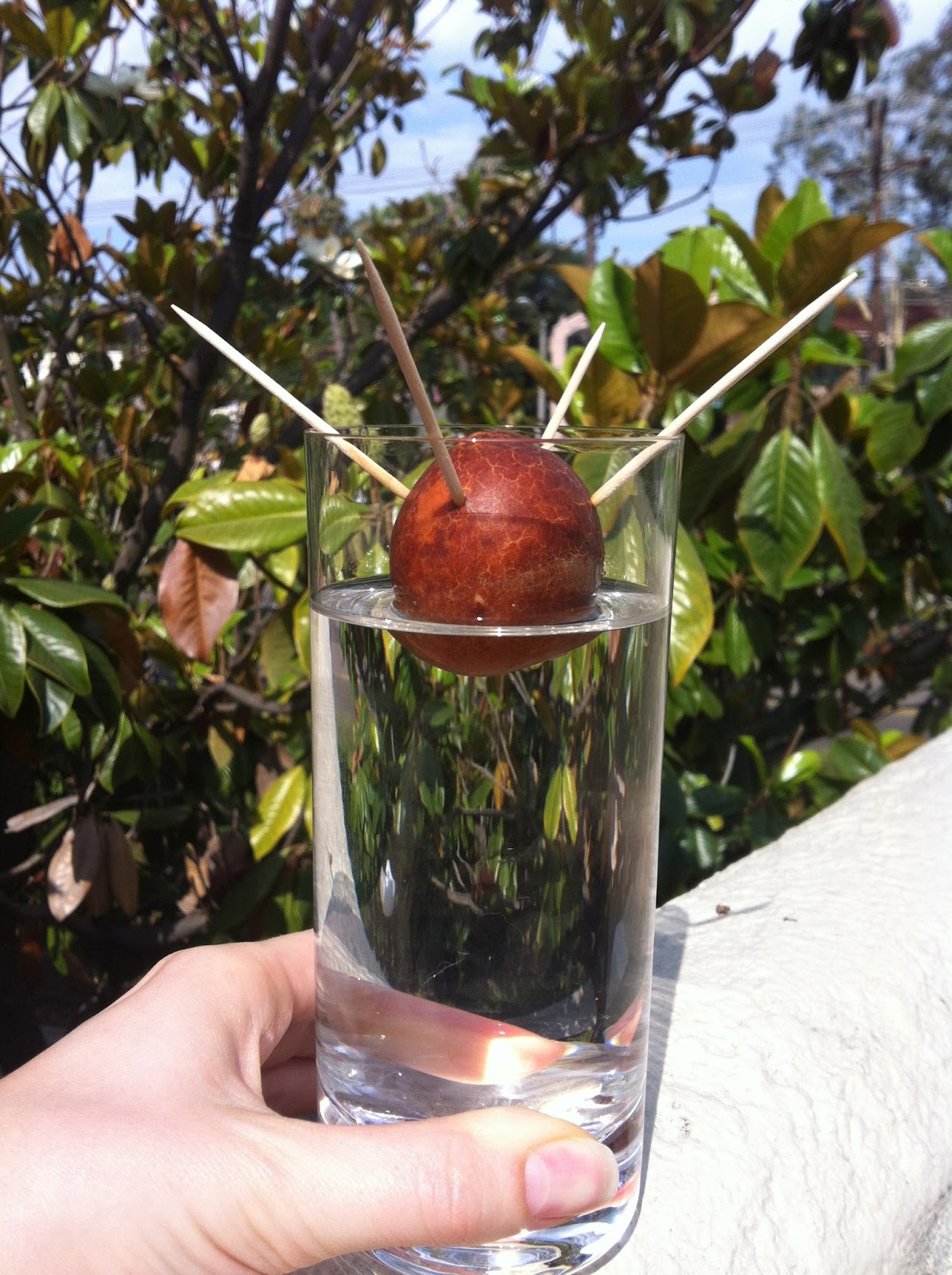
Growing an Avocado Tree at Home
A great way to save money and brighten up your home is sprout your own plants. One of the easiest things you can do is use the seeds and pits you would normally toss out. Avocados make beautiful indoor plants, and if you live in a warm climate, in a few years you can plant it outside to grow a tree! Fruit bearing-trees take many years before they start to give fruit, but are still lovely and rewarding to grow at home. Below are instructions on sprouting an avocado.
1) Cut open a fresh, ripe avocado length-wise and scoop out the pit. Eat the fruit! Yum yum yum.
2) Wash off the pit, removing any traces of fruit.
3) Press 4 toothpicks into the pit, half-way up and around the middle. Use them to balance the pit in a glass of water. The pointy side should be up, and the bottom quarter of the pit should sit in the water.
4) Let the pit rest in the water, keeping it at room temperature or warmer, for a few weeks. If you live in a colder climate or are doing this in the winter, you might want to use a heating pad or a grow lamp.

5) Refill the water as needed to keep the pit moist.
The pit will sprout roots, and eventually will crack in half with a sprout coming out at the top. This will probably take a few months. Once it sprouts, you can transplant it to a pot, gently covering the roots with soil and putting it in a place with plenty of sun.
Sprouting is the hard part, so once you have the sprout you can sit back and enjoy! Until next time, keep it clean!
1) Cut open a fresh, ripe avocado length-wise and scoop out the pit. Eat the fruit! Yum yum yum.
2) Wash off the pit, removing any traces of fruit.
3) Press 4 toothpicks into the pit, half-way up and around the middle. Use them to balance the pit in a glass of water. The pointy side should be up, and the bottom quarter of the pit should sit in the water.
4) Let the pit rest in the water, keeping it at room temperature or warmer, for a few weeks. If you live in a colder climate or are doing this in the winter, you might want to use a heating pad or a grow lamp.

5) Refill the water as needed to keep the pit moist.
The pit will sprout roots, and eventually will crack in half with a sprout coming out at the top. This will probably take a few months. Once it sprouts, you can transplant it to a pot, gently covering the roots with soil and putting it in a place with plenty of sun.
Sprouting is the hard part, so once you have the sprout you can sit back and enjoy! Until next time, keep it clean!
Tuesday, July 2, 2013
Independence Day!
The Fourth of July is coming up quickly! Independence Day, more commonly known as The Fourth of July, is the celebration of the signing of the Declaration of Independence in 1776. The Declaration (you guessed it!) declared our independence from Great Britain as a free and sovereign nation.
Fun Facts:
Here's a fun traditional alternative to regular barbecue sauce for your picnics on Thursday:
Southern Mustard Barbecue Sauce
And because it's inevitable:
How to Remove Barbecue Sauce Stains
Fun Facts:
- Thomas Jefferson and John Adams both died on the same day, which happened to be the 4th of July.
- James Monroe also died on a later 4th of July, making the 3rd President in a row to die on the 4th.
- Calvin Coolidge is our only President to have been born on the 4th of July.
- Congress actually approved the resolution for independence on July 2nd
- Though the Declaration of Independence is dated July 4th, it's thought by historians that many of the signatures weren't added until August
Southern Mustard Barbecue Sauce
- 3/4 cup yellow mustard
- 3/4 cup cider vinegar
- 1 tablespoon light brown sugar
- 1 1/2 tablespoons unsalted butter
- 2 teaspoons salt
- 2 tablespoons Worcestershire sauce
- 1 1/4 teaspoons fresh ground black pepper
- 2 teaspoons hot sauce (to taste)
How to Remove Barbecue Sauce Stains
- Apply detergent to the affected area and soak in warm water for 15 minutes
- Rinse out the detergent and scrub the area with white vinegar
- Run through the wash like normal
Tuesday, June 18, 2013
Preventing Sunburn Inside and Out
We all enjoy a good picnic in the park or day lazing on the beach in the summertime. A little bit of sun is good for us, and even recommended. It may not make you impervious from harm or give you the power of flight, but sunlight is still super for increasing your levels of contentment and boosting the much-needed Vitamin D most of us lack. But what do you do when you want to spend more than 30 minutes in the great outdoors? Here are a few things you can do to protect yourself.
Antioxidant-Rich Diet
Too much sunlight on your skin breaks down your skin cells. You can slow down that breakdown with a diet packed full of nutrition. The nutrients and antioxidants in food will mop up any cell damage and stimulate your cells to produce new healthy cells to replace the damaged ones. The most nutrient dense foods you can eat are dark leafy greens, non-starchy vegetables, berries and citrus fruits, nuts, cocoa, avocados, coffee, tea, olive oil and coconut oil. A healthy diet won't completely protect you from the sun, but it will reduce the damage considerably and help you heal much faster.
Essential Oils
There are a lot of plant oils that naturally prevent sunscreen. Coconut oil is a good start, but add 5 to 10 drops of other oils to boost protection. Myrrh, lavender, helichrysum and red raspberry seed oil all block out a significant percentage of harmful radiation when applied to the skin. Mix essential oil with some coconut oil in a jar and apply every hour or two throughout your time outside.
Cover Up
Anyone who's ever experienced Farmer's Tan or a Phantom Watch knows that clothing will block out sun exposure. bring a swimsuit cover-up like a long-sleeved linen shirt, a hat or a long cotton dress to wear after a swim.
Have a Friend Watch Your Back
Many times you'll be burned way before you even feel it. Hang out with friends, and especially if you burn easy, let them know they can feel free to point it out when you're starting to look red so you can stop it in its tracks before it gets worse.
Soothe the Burn
As careful as you are, it's probably going to happen eventually. Cut a leaf of aloe or mash up a cucumber to cool raw skin, or cut a raw potato and apply directly where it hurts. Bonus points: put the potato in the fridge first. The starch will help soothe your skin. Oatmeal can be used similarly by applying to the skin or soaking in a bath of it. White vinegar will kill the pain too. Apply every 20 minutes to where it hurts the most.
Enjoy your summer fun, and until next time, keep it clean!
Antioxidant-Rich Diet
Too much sunlight on your skin breaks down your skin cells. You can slow down that breakdown with a diet packed full of nutrition. The nutrients and antioxidants in food will mop up any cell damage and stimulate your cells to produce new healthy cells to replace the damaged ones. The most nutrient dense foods you can eat are dark leafy greens, non-starchy vegetables, berries and citrus fruits, nuts, cocoa, avocados, coffee, tea, olive oil and coconut oil. A healthy diet won't completely protect you from the sun, but it will reduce the damage considerably and help you heal much faster.
Essential Oils
There are a lot of plant oils that naturally prevent sunscreen. Coconut oil is a good start, but add 5 to 10 drops of other oils to boost protection. Myrrh, lavender, helichrysum and red raspberry seed oil all block out a significant percentage of harmful radiation when applied to the skin. Mix essential oil with some coconut oil in a jar and apply every hour or two throughout your time outside.
Cover Up
Anyone who's ever experienced Farmer's Tan or a Phantom Watch knows that clothing will block out sun exposure. bring a swimsuit cover-up like a long-sleeved linen shirt, a hat or a long cotton dress to wear after a swim.
Have a Friend Watch Your Back
Many times you'll be burned way before you even feel it. Hang out with friends, and especially if you burn easy, let them know they can feel free to point it out when you're starting to look red so you can stop it in its tracks before it gets worse.
Soothe the Burn
As careful as you are, it's probably going to happen eventually. Cut a leaf of aloe or mash up a cucumber to cool raw skin, or cut a raw potato and apply directly where it hurts. Bonus points: put the potato in the fridge first. The starch will help soothe your skin. Oatmeal can be used similarly by applying to the skin or soaking in a bath of it. White vinegar will kill the pain too. Apply every 20 minutes to where it hurts the most.Enjoy your summer fun, and until next time, keep it clean!
Tuesday, June 11, 2013
Natural Skin Care
It's no secret here at Azuma that we dig the natural lifestyle. One of the things that I'm most proud of are all the compliments on my glowing skin. The great thing is, there's really no magic or expensive secret to keeping it clean, gorgeous and healthy. Here's my regimen for looking fresh.
Baking Soda
The easiest and cheapest trick in the book. Forget expensive exfoliating gels and creams. Baking soda is proven to do it all. Removes dead skin cells, whitens and brightens uneven color and dark splotches, removes blackheads, and alkalizes the skin surface to prevent zits from getting out of control. Just put about a teaspoon in your hand, add a little water, and scrub in the morning and before bed.
Witch Hazel
It's not magic, just a wonderful plant with great astringent qualities. You can get witch hazel extract for cheap in the first aid aisle of most grocers, but fancier scented varieties such as Thayer's are also out there. The antioxidants fight acne, relieve eczema and psoriasis, and soothes swelling and cracked, dry skin. I like to wipe down my face with it after removing make-up or scrubbing with baking soda. It also works great as an aftershave! No more razor bumps.
Aloe
Aloe is also a wonderful skin soother and mild moisturizer. Keep some in the fridge for days when you're a bit puffy and smooth it on your face. I also mix aloe as a carrier for other oils as a daily moisturizer.
There are a few different oils to choose from for moisturizer. Some prefer castor oil, some like coconut or avocado, but I've found the one that least irritates my face and delivers the right amount of moisture without clogging my pores is Sweet Almond. All of these natural oils have amino acid chains similar to the oils your skin naturally produces. That means that it soaks in and penetrates rather than just sitting on the top and sealing in what oil you have. I put half and half almond oil and aloe into a travel bottle, shake it up and squeeze out a dime sized amount when I need lotion for my face.
Eat Right
I know, I know. We've heard it a million times. But it is SO important to eat your cruciferous veggies and greens. The nutritional powerhouses are packed with antioxidants that clean your body inside and out and leave you with a healthy beautiful glow. I firmly believe my plant-strong diet is the biggest reason why my skin stays healthy and young. Kale, arugula, broccoli, collards, romaine, chard, cauliflower, mustard greens galore!
Exercise
Some type of movement every day keeps your blood moving, delivering important nutrients and oxygenating your cells, triggering the hormonal responses necessary to make new cells and revitalize your skin. Running, walking, yoga, playing with your children, swimming, biking. Science has proven time and again that those of us who stay young mentally and physically exercise regularly. Whatever it is you do, keep active.
Until next time, keep it clean!
Tuesday, June 4, 2013
How to Keep Your Cat from Waking You Up
Most cat owners have experienced their cat pouncing on their face at 5AM. It's an irritating experience, especially on a Sunday morning! Contrary to popular belief, cats can be trained. Here are a few tips for how to get your cat on your sleep schedule.
Listen to Your Cat
When a cat is "misbehaving", it's usually for a reason. This includes pouncing on your face in the morning. If your cat is exhibiting unusual behavior, it may mean that something in his environment has been interrupted (like a new cat in the neighborhood) or that he may be sick. Training a cat or any pet means teaching it to live alongside you within your rules, but within reason. Remember that animals, much like small children, can't communicate to us except with noises and gestures. Just like with a child, check to see that their basic needs are met first and then try and figure out if something is wrong beyond that.
Fulfill the Basics
Most cats are very territorial and like to feel that their territory stays a particular way. If you feed your cat and clean its box sporadically, this can make it feel insecure, resulting in weird behaviors to get your attention. Clean the box at LEAST once a week on the same day, completely change the litter once a month, and have specified times that you feed your cat, always giving fresh water. The easiest schedule is once before you go to work and once before you go to bed. If they feel their needs are not being met, most cats will do whatever it takes to get your attention, even if it's negative-- like scratching the furniture or knocking things off the shelf.
Keep Your Cat Entertained
Cats are nocturnal and naturally like to explore at night. But if they get their "hunting" out during the day, they're less likely to need to do it while you're snoozing. If you're away most of the day, leave them puzzles, balls and toys to play with. Cats get bored just like people, so try and keep most of their toys hidden away and then give them one or two in the morning. An old toy will feel new and exciting again if they haven't seen it in a while. Be sure to interact with your cat, too. Playing with a fishing toy or a piece of yarn, or even playing fetch are all great games that will help you bond with your cat and wear him out, too.
Make a Bedtime Routine Your Cat Understands
To help your cat wind down and be ready to sleep when you are, before you go to bed remember to Play, Feed and Groom. If your cat goes outside, let him roam his territory for a couple hours and call him in at the same time each night. (If you consistently give your cat treats for responding, just like a dog he will come when you call.) If your cat is an indoor cat, play with him to wear him out. Feed your cat after playing. Once he's done, brush him to finish calming him down. These are all natural things cats do before sleeping: hunt, eat, clean themselves up and nap.
Avoid the Signals
Cats are keen to notice sights and sounds that signify morning. Keep the shades closed so the sun doesn't pour in, use a fan or a white noise machine at night to drown out the sounds outside. The more consistent you can keep your sleeping area, the better.Resist Fighting Back
If your cat is annoying you, it's hard to fight the urge to think they're just doing it to torture or spite you. Reacting in any way is giving your cat attention and going to reinforce bad habits. It may take several days for your cat to learn to sleep at night. Be strong! Try not to acknowledge your cat when he wakes you up in the morning, not even locking him out of the room or pushing him off the bed. Eventually he'll understand that you will get up and feed him and play with him if he waits.
Subscribe to:
Posts (Atom)

.png)