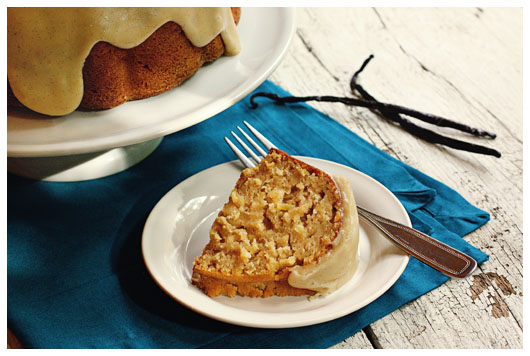
With the holidays upon us I have been looking all over the place for the perfect recipe for our families thanksgiving get together! I always love pie, but its very traditional for thanksgiving and I wanted to try bringing something a bit different. I opted for a cake! I found this fabulous recipe online and wanted to share! :)
Apple
Bundt with Brown-Butter Vanilla Bean Glaze

for the apple bundt:
1 T. butter and some flour for preparing the pan
4 medium apples – peeled, cored, & shredded (use the big holes on your grater), to make about 3-1/2 cups shredded apples – I used 2 Granny Smith, 1 Gala, and 1 McIntosh
1 T. fresh squeezed lemon juice
1-1/3 c. white sugar, divided
3 c. all-purpose flour
1 T. baking powder
1 T. cinnamon
1/2 tsp. mace
1/4 tsp. nutmeg
1 tsp. salt
1 c. brown sugar
1/2 c. vegetable oil
1/2 c. applesauce
4 large eggs
1/2 c. apple cider
2 tsp. vanilla
1 T. butter and some flour for preparing the pan
4 medium apples – peeled, cored, & shredded (use the big holes on your grater), to make about 3-1/2 cups shredded apples – I used 2 Granny Smith, 1 Gala, and 1 McIntosh
1 T. fresh squeezed lemon juice
1-1/3 c. white sugar, divided
3 c. all-purpose flour
1 T. baking powder
1 T. cinnamon
1/2 tsp. mace
1/4 tsp. nutmeg
1 tsp. salt
1 c. brown sugar
1/2 c. vegetable oil
1/2 c. applesauce
4 large eggs
1/2 c. apple cider
2 tsp. vanilla
Preheat oven to 350°. Prepare a 12-cup
bundt pan by smearing butter over every little nook and cranny of its
interior. Then add some flour and tilt your pan so flour sticks to all
of the buttery surface. Set pan aside.
Stir the shredded apple with lemon juice
and 1/3 cup of the white sugar. Set aside.
In a medium bowl, whisk together the
flour, baking powder, cinnamon, mace, nutmeg, and salt. Set aside.
In the bowl of a stand mixer, combine
the remaining 1 cup white sugar, brown sugar, oil, applesauce, eggs,
apple cider, and vanilla. Mix to combine. Then add the flour mixture and
combine once again. Add the apples and mix until the apples are evenly
distributed. Pour into prepared Bundt pan and bake for 1 hour, or until a
toothpick comes out of the cake clean. Cool the cake in the pan for 10
minutes, then invert onto your serving platter.
**If
you are going to top the cake with the glaze, start making the glaze
immediately, while the cake is still warm!
Another option for serving this cake
would be to finish it with a simple dusting of powdered sugar once it is
cool. A dollop of slightly sweetened whipped cream or a scoop of
vanilla bean ice cream would also be very good.
for the brown-butter vanilla
bean glaze:
2 to 3 T. half and half
2 c. sifted powdered sugar
vanilla bean seeds scraped from 1/2 a vanilla bean (split bean lengthwise and scrape out seeds)
4 oz. butter
2 tsp. vanilla
2 to 3 T. half and half
2 c. sifted powdered sugar
vanilla bean seeds scraped from 1/2 a vanilla bean (split bean lengthwise and scrape out seeds)
4 oz. butter
2 tsp. vanilla
First, pour 3 tablespoons of half and
half into a small bowl and set aside. This is just to take the chill
off, while you prepare the rest of the glaze.
In a medium mixing bowl, combine the
sifted (don’t skip the sifting!) powdered sugar and vanilla bean seeds.
Set aside.
 In a large saucepan over medium-low
heat, warm the butter until golden brown. It should smell delicious and
toasty. If it smells burnt, you went too far! This should take about 6
to 8 minutes. Carefully pour browned butter into the powdered sugar and
vanilla bean seeds, leaving the darkened butter sediment behind. Add 2
tablespoons of the half and half, then add the vanilla. Stir vigorously
until smooth. You want the glaze to be somewhat thick, but easily
pourable. If it seems too thick, add the remaining tablespoon of half
and half.
In a large saucepan over medium-low
heat, warm the butter until golden brown. It should smell delicious and
toasty. If it smells burnt, you went too far! This should take about 6
to 8 minutes. Carefully pour browned butter into the powdered sugar and
vanilla bean seeds, leaving the darkened butter sediment behind. Add 2
tablespoons of the half and half, then add the vanilla. Stir vigorously
until smooth. You want the glaze to be somewhat thick, but easily
pourable. If it seems too thick, add the remaining tablespoon of half
and half.
Pour the
glaze over the cake while both the glaze and cake are still warm.
The glaze cools quickly, so don’t delay! Let the glaze set. Then slice and enjoy!
Until next time, keep it clean! :)
Until next time, keep it clean! :)


 Posts
Posts